
How to identify birds: a 6-step guide
Work through these clues in order. Size and shape narrow it down faster than color alone.
Size
Compare it with birds you already know: sparrow-sized (about 15 cm), robin-sized (about 25 cm), crow-sized (about 45 cm) or bigger.
Shape
Look at the bill (thin for insects, thick and conical for seeds, hooked for meat), the tail length, a crest, and long legs or neck.
Color pattern
Note the main color, then the details that stand out: a cap, an eye stripe, wing bars, a breast spot or a colored shoulder.
Behavior
Is it hopping on the ground, climbing a trunk, hovering, wading, soaring in circles or perched on a wire?
Habitat
Backyard feeder, open field, marsh, pond, forest edge or coastline. Many birds are easiest to find in one kind of place.
Sound
Songs and calls often identify a bird before you see it. A sound ID app such as Merlin can suggest matches while you listen.
Find a bird by color
Tap a bird to open its full species page.
Black


Black & white

Blue
 Blue JayCrested, blue above and whitish below with a black necklace; loud, var…
 Eastern BluebirdBright blue back with a rusty-orange breast; perches on wires and fenc…
 Barn SwallowGlossy blue above, rusty below, with a deeply forked tail; flies low o…
 Belted KingfisherBlue-gray with a big shaggy crest and a blue breast band; females also…
Brown
 Mourning DoveSlender, soft gray-brown dove with a long pointed tail and black wing …
 Song SparrowStreaky brown sparrow, often with a dark central spot on the breast.…
 Bald EagleHuge dark-brown raptor; adults have a white head and tail and a yellow…
 Red-tailed HawkBulky hawk, pale below with a dark belly band; adults have a rusty red…
 Canada GooseLarge brown goose with a black neck and head and a white chinstrap.…
 Cedar WaxwingSleek, crested and silky tan with a black mask and a yellow-tipped tai…
 Carolina WrenRich brown wren with a bold white eyebrow and a cocked tail; very loud…
 OspreyBrown above, white below, with a dark eye stripe; hovers and dives fee…
 Great Horned OwlBig owl with feathered ear tufts, yellow eyes and a white throat patch…
Gray
 Black-capped ChickadeeTiny, with a black cap and bib, white cheeks and a gray back.…
 Dark-eyed JuncoGray or brown sparrow with a pale bill and white outer tail feathers t…
 Tufted TitmouseSmall gray bird with a crest, big dark eyes and rusty flanks.…
 White-breasted NuthatchGray-blue back, white face and belly; climbs headfirst down tree trunk…
 Northern MockingbirdSlim and gray with a long tail and white wing patches; mimics other bi…
 Great Blue HeronVery tall gray-blue heron with a long neck and dagger bill; wades slow…
Green


Orange


Red


Tricky look-alikes
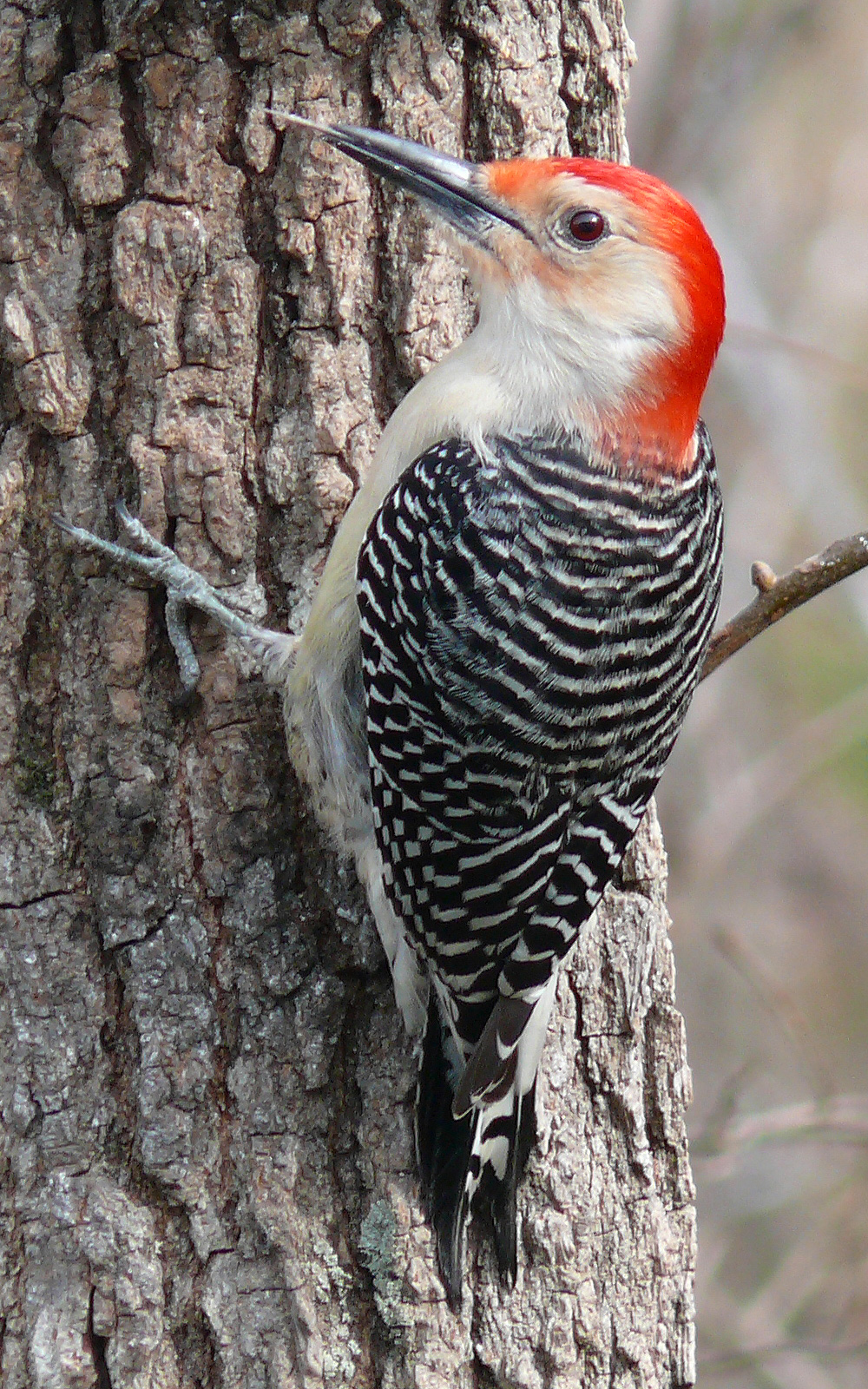
Downy Woodpecker vs Red-bellied Woodpecker
Both are black and white. The Downy is small with a plain white back; the Red-bellied is bigger with a barred back and a red cap.
House Finch vs Northern Cardinal
Both males show red, but the cardinal is all red with a crest and black face; the House Finch is streaky brown with red on the head and breast.
American Crow vs Red-winged Blackbird
Both can look all black. The crow is much larger with a heavy bill; the male Red-winged Blackbird is robin-sized with red shoulder patches.
Osprey vs Bald Eagle
The Osprey is white below with a dark eye stripe; an adult Bald Eagle is dark-bodied with a white head and tail.
Questions people ask
What are field marks?
Field marks are the visible features that separate one species from similar ones, such as a white eyebrow stripe, wing bars, a crest or a colored patch.
What is the easiest way to identify birds as a beginner?
Start with the birds at your own feeder or yard, compare size and shape before color, and check your guess against photos. Free apps like Merlin Bird ID can suggest matches from a photo or a recording.
Why do males and females of some species look different?
In many songbirds, ducks and other groups, males are brighter while females are duller for camouflage. The Northern Cardinal, House Finch, Red-winged Blackbird and Mallard are clear examples on this site.